Google Ads can report clicks, calls, and form submissions. Those numbers are useful, but they do not tell you whether the leads were qualified or whether they became customers.
A campaign may produce a low cost per lead while filling the sales pipeline with poor opportunities. Another campaign may generate fewer inquiries but create larger and more profitable deals. Without CRM tracking, both marketing and sales teams are making decisions with incomplete information.
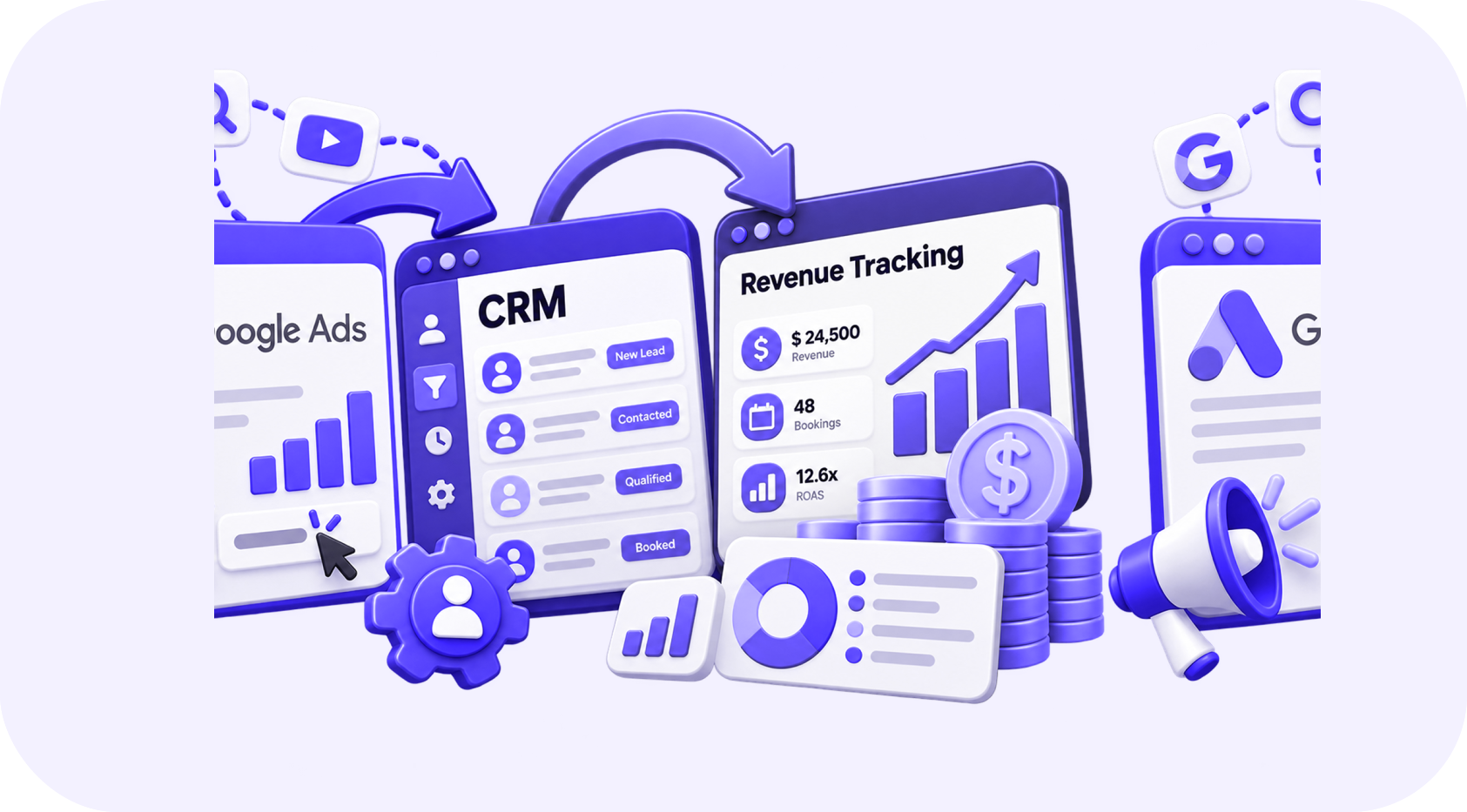
Closed-loop tracking connects the advertising click with the final business outcome.
The most valuable campaign is not always the one producing the most leads. It is the one producing the right customers at a sustainable cost.
01Why Platform Conversion Data Is Not Enough
For an ecommerce purchase completed online, the path may be relatively direct. Service businesses, SaaS companies, real estate teams, construction firms, and advisors often have a longer journey.
A lead may:
- Click an advertisement
- Visit several pages
- Submit a form or call
- Speak with a representative
- Book a consultation
- Receive a proposal
- Make a decision weeks later
If tracking stops at the form, Google Ads receives no information about the later stages. The campaign is optimized around generating submissions rather than qualified revenue.
02What the Connected Data Flow Looks Like
Capture the advertising identifiers
When a person arrives from an ad, preserve the available click and campaign information with the form or session.
Create the CRM record
Store the contact, original source, campaign, landing page, and other useful attribution details.
Track sales stages
Update the opportunity as it becomes contacted, qualified, booked, proposed, won, or lost.
Define meaningful conversions
Decide which later events matter enough to send back for advertising measurement, such as a qualified lead, completed appointment, or closed deal.
Return eligible conversion data
Use an approved integration or offline conversion process that follows current privacy and platform requirements.
Compare spend with results
Build reporting that connects advertising cost with qualified pipeline and revenue.
03Decide Which Outcomes Matter
Do not send every CRM update as an equally valuable conversion. Define a small set of events that reflect genuine progress.
| Funnel event | Why it matters |
|---|---|
| Lead created | Measures initial response to the campaign |
| Qualified lead | Shows whether targeting attracts suitable prospects |
| Appointment completed | Indicates deeper intent and sales engagement |
| Proposal sent | Represents a real commercial opportunity |
| Closed won | Connects advertising with customer revenue |
For long sales cycles, waiting only for closed revenue may give the advertising system too little or too-late feedback. A carefully defined qualified-lead event can provide an earlier signal while revenue reporting remains the final business measure.
04Create Reliable CRM Stages
Closed-loop reporting depends on consistent sales data. If representatives use stages differently or leave records unchanged, the attribution report will be misleading.
Define each stage with entry and exit rules. For example, a lead should not become qualified only because someone opened an email. Qualification may require the correct service need, location, budget, authority, and timeline.
Require a reason when an opportunity is marked lost. This helps marketing distinguish irrelevant traffic from pricing concerns, timing issues, or sales-process problems.
05Track Calls and Forms Carefully
Many high-intent leads call instead of completing a form. Use appropriate call tracking to connect calls with campaigns while preserving the customer experience and meeting local requirements.
Forms should pass source information into the CRM without trusting editable hidden fields as the only record. Test what happens across mobile devices, cookie choices, repeated visits, and different landing pages.
No attribution setup will be perfect. The goal is a dependable decision system, not a claim that every interaction can be identified with absolute certainty.
06Avoid Common Attribution Mistakes
- Counting spam and duplicate submissions as conversions
- Treating every lead as equally valuable
- Losing source data during CRM creation
- Overwriting the original source with the latest interaction
- Failing to track phone leads
- Sending sensitive customer information unnecessarily
- Optimizing before enough reliable data exists
- Ignoring the influence of organic, referral, email, and direct channels
Use separate fields for original source and recent source when both views are important.
07Build a Revenue-Focused Dashboard
A useful management dashboard should show:
- Advertising spend by campaign
- Leads and valid leads
- Qualified opportunities
- Appointments booked and completed
- Proposals or applications
- Closed customers
- Pipeline value and won revenue
- Cost per qualified opportunity
- Customer acquisition cost
- Conversion time by campaign
Compare performance over a realistic period. A construction or advisory lead may need much longer to close than a simple appointment-based service.
08Use the Information to Improve the Complete Journey
When advertising and CRM data are connected, the team can ask better questions.
If clicks are strong but forms are weak, review the landing page and offer. If forms are strong but qualification is poor, review targeting and keywords. If qualified leads are not booking, review response time and follow-up. If appointments do not close, review the sales conversation, pricing, or fit.
Marketing performance cannot be separated completely from the process that handles the lead.
09Protect Privacy and Data Quality
Collect only the information required for the business purpose. Use consent and disclosure appropriate to the region, industry, and tracking method. Restrict access to CRM and advertising accounts, and do not upload sensitive information that the platform does not require.
Assign clear ownership for tracking. Marketing, sales, and technical teams should agree on field definitions, conversion rules, and how errors will be monitored.
10Move From Lead Counting to Revenue Decisions
Connecting Google Ads with your CRM changes the conversation. Instead of asking which campaign produced the cheapest form, you can ask which campaign created qualified pipeline, closed customers, and profitable growth.
That is the information founders and marketing leaders need to allocate budget with confidence.
Written by
The InvexTech Team
We design and build AI, CRM and software systems for growing businesses, and write about what we learn doing it.